CBRNE INTELLIGENCE ASSESSMENT
Chemical, Biological, Radiological, Nuclear and Explosive Defense Posture at the 2026 FIFA World Cup (United States Venues)

Reporting date: 25July 2026
Scope: US venues only. Canadian and Mexican CBRNE architecture is a declared collection gap.
Method: primary-source OSINT, claim-level provenance, ICD-203 confidence.
WHAT THIS ASSESSMENT IS, AND WHAT IT IS NOT
This is a CBRNE-specific product. It assesses only the chemical, biological, radiological, nuclear and explosive defence posture of the tournament’s US venues. It is not a general security report. Threats outside the CBRNE remit (cyber, crowd safety, general counterterrorism) are addressed only where they intersect the CBRNE mission.
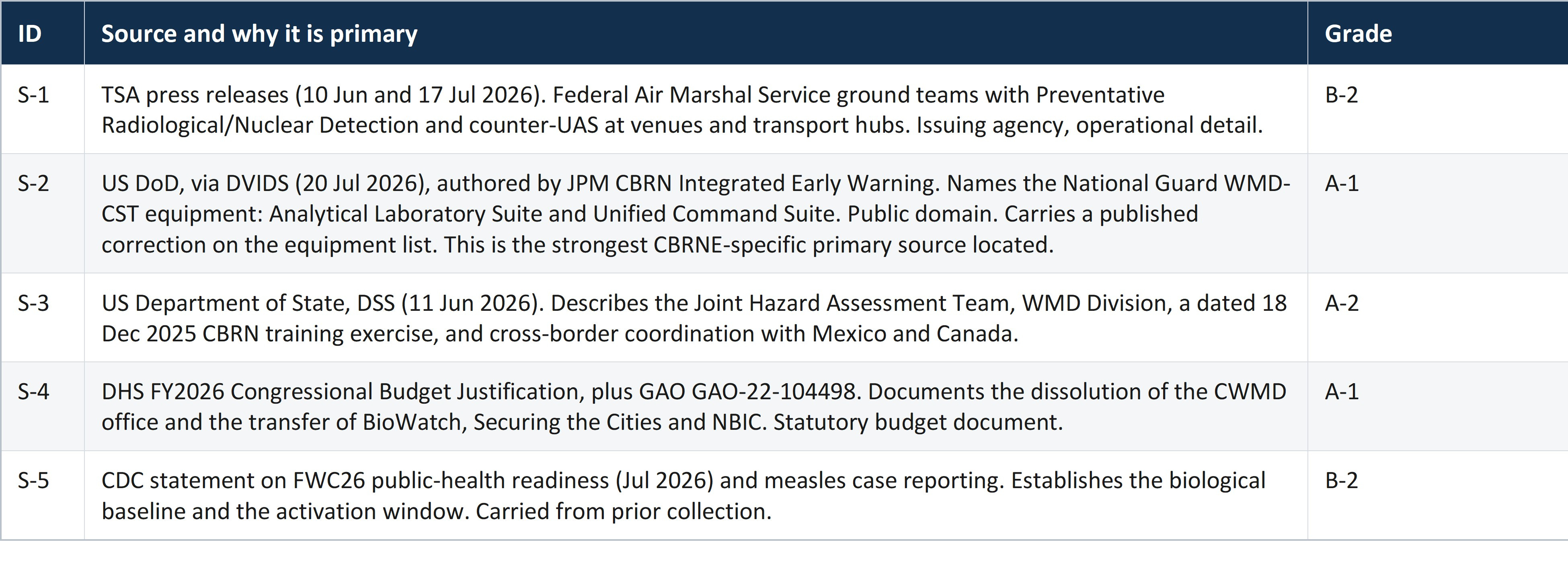
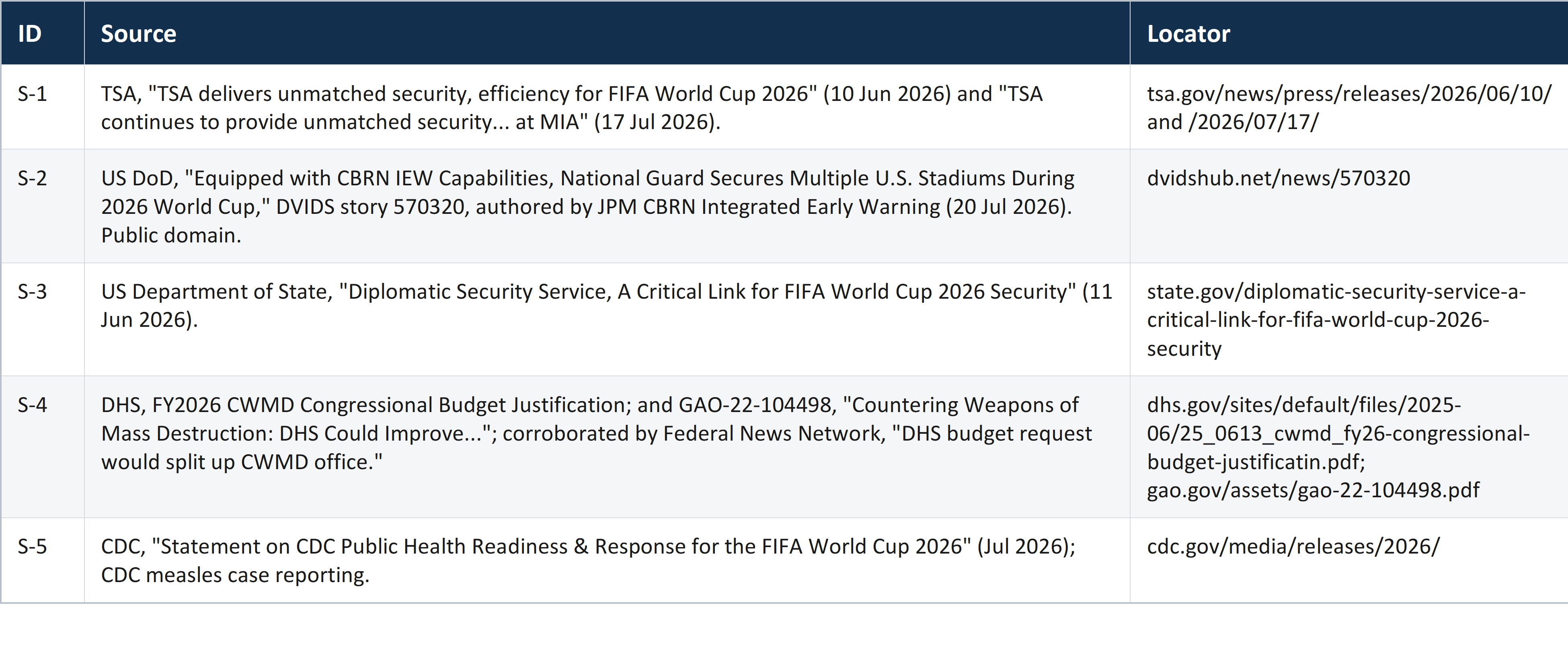
It is built from firsthand documents. The spine is a small set of primary sources: a US Department of Defense public-affairs release naming the deployed CBRN equipment, a US Department of State release describing the interagency hazard-assessment team, TSA operational releases, and the DHS FY2026 budget justification. Press aggregation of these was treated as corroboration, never as independent sourcing.
It is honest about what is missing. Chemical point-detection at venues, biological collector placement, host-city hospital surge capacity, and the entire Canadian and Mexican picture are undocumented in open sources. These are recorded as explicit gaps, not filled by inference.
EXECUTIVE SUMMARY
Bottom line up front
The 2026 FIFA World Cup closed with no reported CBRNE incident at any US venue. A layered CBRNE detection and response architecture was demonstrably deployed, anchored by radiological and nuclear detection at venues and transport hubs and by National Guard confirmatory-identification teams held in reserve. That outcome is real. It was also achieved while the federal government’s dedicated CBRNE coordinating office was being dissolved and its programmes redistributed, which is the single most important and least reported fact of the tournament’s CBRNE posture.
Confidence in the deployment is high because it rests on primary sources that name specific programmes and equipment. Confidence in the adequacy of that deployment is low, because the metrics that would demonstrate adequacy, detector density, coverage geometry, chemical point-detection at venues, and hospital surge capacity, are not in the public record and cannot be inferred.
Key judgements
KJ-1 | CONFIDENCE: HIGH | EVIDENCE: STRONG
A layered CBRNE detection and response architecture was deployed across US venues. It is firsthand-documented across at least four independent federal organisations: TSA and the Federal Air Marshal Service for radiological and nuclear detection [S-1]; the National Guard Weapons of Mass Destruction Civil Support Teams for confirmatory identification and response [S-2]; the State Department Diplomatic Security Service Joint Hazard Assessment Team for interagency hazard assessment [S-3]; and the DHS enterprise for programme ownership [S-4].
No CBRNE incident at any US venue has been reported by any source.
KJ-2 | CONFIDENCE: HIGH | EVIDENCE: STRONG
Radiological and nuclear detection was the most mature and best-documented CBRNE capability at the tournament. The Federal Air Marshal Service deployed ground-based teams carrying Preventative Radiological and Nuclear Detection technology and personnel to venues and nearby transportation hubs, a posture reaffirmed for the final weekend [S-1].
This is consistent with the long-standing federal emphasis on radiological and nuclear detection at mass events through the Securing the Cities and Radiation Portal Monitor programmes [S-4].
KJ-3 | CONFIDENCE: HIGH | EVIDENCE: STRONG | THE FRAMING FACT
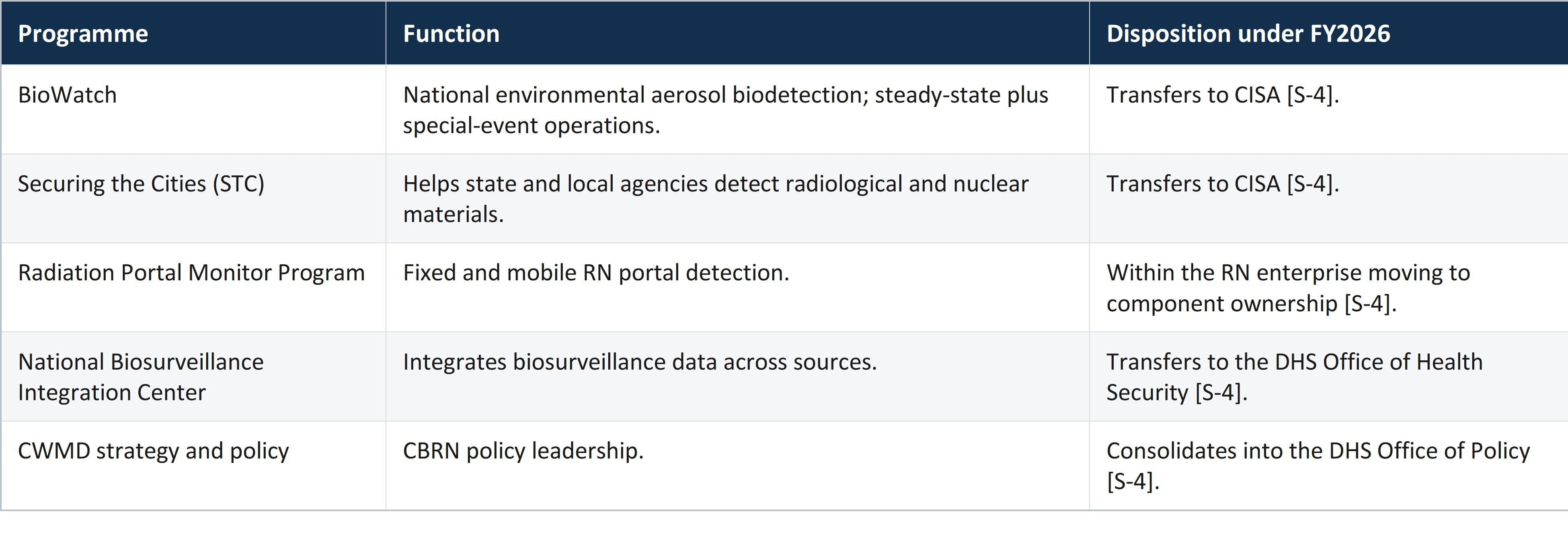
The tournament’s CBRNE defence ran on an architecture in mid-reorganisation. The DHS FY2026 budget justification dissolves the Countering Weapons of Mass Destruction office, transferring 286 positions, 263 full-time equivalents and 306.2 million dollars to other components, with BioWatch and Securing the Cities moving to CISA and the National Biosurveillance Integration Center moving to the Office of Health Security [S-4].
ASSESSMENT: any judgement about CBRNE readiness at FWC26 must be made against a coordinating architecture that was being taken apart during the same budget cycle. Whether this degraded capability during the event is not determinable from open sources and is the highest-priority question for post-event oversight.
KJ-4 | CONFIDENCE: MODERATE | EVIDENCE: MEDIUM
National Guard WMD Civil Support Teams provided the confirmatory-identification and response layer, held on standby rather than forward-screening. The Analytical Laboratory Suite, a mobile laboratory for field-confirmatory chemical and biological agent identification, was on standby; the Unified Command Suite provided secure interagency communications [S-2].
A published correction to the source release states the CBRN Support to Command and Control capability was NOT used during the event. This level of specificity, including a public correction of the equipment list, is a marker of an authentic primary source.
KJ-5 | CONFIDENCE: LOW TO MODERATE | EVIDENCE: WEAK | PROVISIONAL
No World Cup-linked biological outbreak has been publicly identified, but the biological picture is the least resolved and the observation window is still open. The United States entered the tournament amid a significant measles resurgence, and the CDC public-health activation runs through 31 July 2026. Measles incubation of seven to twenty-one days means cases seeded in the final week will not present until early August [prior collection, S-5].
REVISIT: T+30 (mid-August) and T+60 (late September).
KJ-6 | CONFIDENCE: HIGH | EVIDENCE: STRONG
Chemical point-detection at venues is the weakest-documented CBR domain. Firsthand sources establish confirmatory identification capability, the Joint Hazard Assessment Team and the Analytical Laboratory Suite, but describe no venue-level chemical point-detection sensor architecture [S-2, S-3]. This is a documentation gap, not a demonstrated capability gap: absence of open reporting is not absence of capability, and equally is not evidence of it.
KJ-7 | CONFIDENCE: HIGH | EVIDENCE: STRONG | SCOPE LIMIT
The Canadian and Mexican CBRNE picture is a structural gap. The State Department confirms cross-border CBRNE coordination with Mexican and Canadian authorities existed [S-3], but no Canadian or Mexican primary source on CBRNE posture was located in open sources. For a tri-national event, this assessment covers only the US fraction and says so plainly.
1 | SOURCING AND METHOD
1.1 The firsthand spine
This assessment is deliberately built on a small number of primary documents rather than a large number of news articles. In CBRNE reporting, a single agency statement is frequently republished across dozens of outlets; counting those as independent sources manufactures false corroboration. The sources below are the load-bearing primaries. Each names specific programs, equipment or figures that could not originate in secondary reporting.
1.2 The aggregation trap, illustrated
The TSA radiological-detection sentence at S-1 was located this session in at least a dozen separate outlets, including newswire syndicators and portal aggregators. Every one of them reproduced the same single TSA sentence. Under the method used here, that entire set counts as one source at one grade, because none of them adds independent observation. This is the practical reason the assessment is built on primaries: it is the only way to avoid mistaking republication for corroboration.
1.3 Confidence and gaps
Confidence expressions follow Intelligence Community Directive 203, with confidence in a judgement reported separately from the strength of the evidence beneath it. Where the open-source record is silent, the silence is recorded as a numbered gap in Annex A rather than filled by inference. This matters more in CBRNE than in most domains, because detection architecture detail is routinely and legitimately withheld for operational-security reasons; the correct analytic response to that withholding is to mark a gap, not to assume either adequacy or failure.
2 | STRATEGIC CONTEXT: A CBRNE ARCHITECTURE IN MID-REORGANISATION
The dominant contextual fact of FWC26’s CBRNE posture is organisational, and it is firsthand-sourced. During the same period as the tournament, the Department of Homeland Security was dissolving the office responsible for coordinating the federal CBRNE mission.
2.1 What the budget document says
The DHS FY2026 Congressional Budget Justification transfers 286 positions, 263 full-time equivalents and 306.2 million dollars in operations, support and federal-assistance funding out of the Office of Countering Weapons of Mass Destruction and into other components [S-4]. Under the reorganisation, strategy and policy functions consolidate into the DHS Office of Policy; the National Biosurveillance Integration Center moves to the Office of Health Security; and the operational detection programmes, including BioWatch and Securing the Cities, move to CISA [S-4].
Independent reporting on the budget request corroborated the direction, describing the elimination of the CWMD directorate and the redistribution of its marquee programmes, including BioWatch and Securing the Cities, to CISA and other components [S-4 corroboration].
2.2 Why this matters for the assessment
KEY JUDGEMENT DETAIL | CONFIDENCE: HIGH ON THE FACT, LOW ON THE EFFECT
The FWC26 CBRNE operation succeeded, on the available evidence, while its coordinating office was being taken apart. Two readings are consistent with this and open sources do not separate them.
Reading A: the operational programmes (BioWatch, Securing the Cities, WMD-CST deployment, PRND) are executed by field components and were unaffected by a headquarters reorganisation, so the transition was invisible at the venue.
Reading B: coordination, exercise cadence and reach-back were degraded by the disruption in ways that did not surface because no incident tested them.
The tournament did not experience a CBRNE incident, so the failure mode that would distinguish A from B was never exercised. This is the highest-priority question for the post-event oversight identified in Annex A.
2.3 The programmes in transition
3 | CBRNE POSTURE BY DOMAIN
3.1 Radiological and nuclear: the mature domain
Radiological and nuclear detection is the best-documented CBRNE capability at FWC26 and the one with the deepest institutional lineage. The Federal Air Marshal Service deployed specialised ground-based operations teams equipped with Preventative Radiological and Nuclear Detection technology and personnel to venues and nearby transportation hubs, and this posture was explicitly reaffirmed for the final weekend at Miami [S-1].
This sits on top of the standing federal RN architecture: the Securing the Cities programme, which builds state and local RN detection capacity, and the Radiation Portal Monitor enterprise [S-4]. The National Guard WMD-CST layer added confirmatory RN identification on standby [S-2].
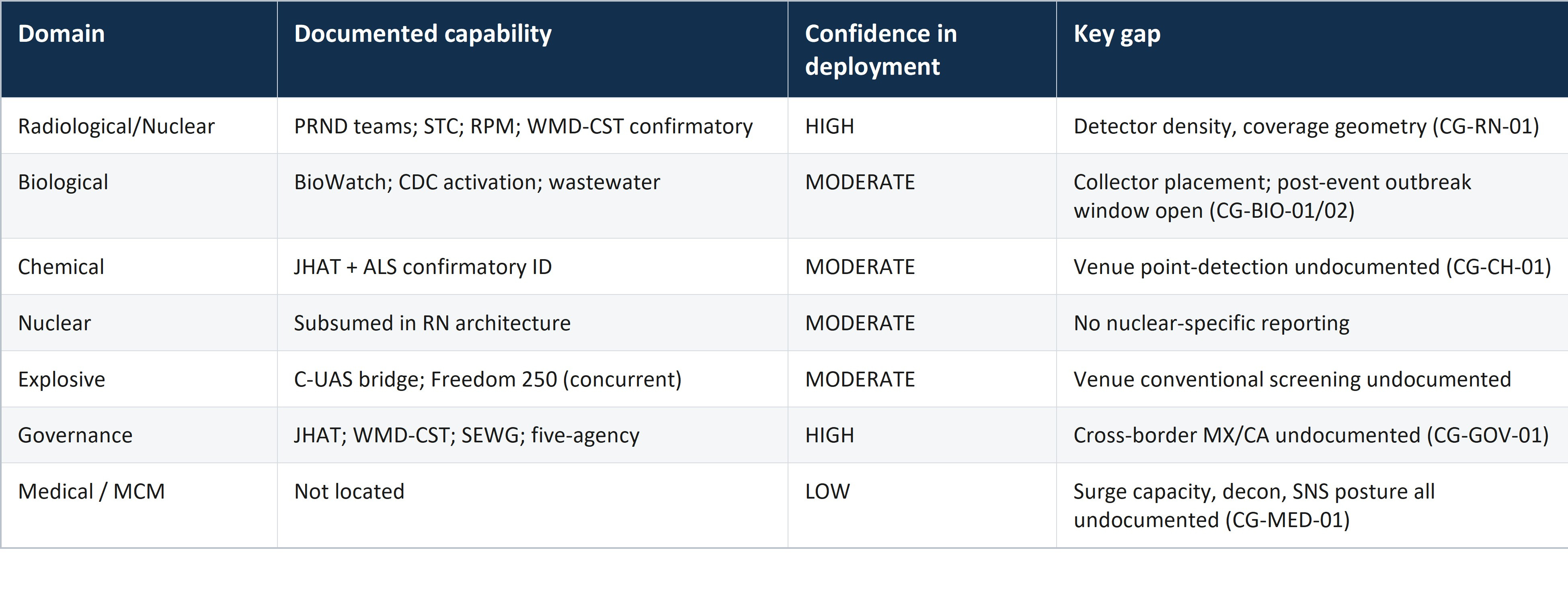
ASSESSMENT (Confidence: HIGH, Evidence: STRONG). RN detection was deployed and layered. What is not documented, and therefore recorded as gap CG-RN-01, is detector density, portal count and coverage geometry. The presence of the capability is firmly established; its sufficiency is not assessable from open sources.
3.2 Biological: the least resolved domain
The biological posture had two layers: environmental detection through BioWatch, the national aerosol biodetection programme that runs special-event operations [S-4], and public-health surveillance through the CDC activation, including wastewater monitoring, running through 31 July 2026 [S-5].
The dominant realised biological risk was not deliberate. It was ordinary communicable-disease transmission across an unprecedented international mixing event, layered on a domestic measles resurgence. The United States entered the tournament with a measles case count exceeding two thousand and rising through the tournament window [S-5].
ASSESSMENT (Confidence: LOW to MODERATE, Evidence: WEAK, PROVISIONAL). No World Cup-linked outbreak has been publicly identified, but the observation window has not closed. Measles incubation of seven to twenty-one days means final-week seeding presents in early August, and international dispersal fragments the signal across national systems. BioWatch collector count and placement at venues are not public (gap CG-BIO-01). The biological judgement is explicitly provisional with revisit triggers at T+30 and T+60.
3.3 Chemical: the documentation gap
Firsthand sources establish a chemical confirmatory-identification capability but not a venue-level point-detection architecture. The State Department Joint Hazard Assessment Team, working through its WMD Division, trains to identify and evaluate chemical threats at large-scale events, and conducted a dated exercise on 18 December 2025 in preparation for the tournament [S-3]. The National Guard Analytical Laboratory Suite provides mobile field-confirmatory identification of chemical and biological agents [S-2].
Both of these are confirmatory: they identify an agent once a hazard is suspected. Neither is a distributed point-detection sensor grid that would provide early warning of a chemical release at a venue. Whether such a grid was deployed is not addressed in any located primary source.
NOTE ON THE MONTERREY CS-AGENT EVENT
A chemical agent was used at the tournament, but not as a CBRNE attack. At the Monterrey fan festival on approximately 1 July 2026, law-enforcement riot-control CS agent was deployed against a crowd surge, contributing to a stampede. This is a crowd-management and public-order event involving a chemical irritant, not a CBRNE threat in the sense of this assessment, and it occurred in Mexico, outside this product’s US venue scope. It is noted here only to prevent it being miscategorised as a chemical-threat realisation.
ASSESSMENT (Confidence: HIGH on the gap, Evidence: STRONG). Chemical is the weakest-documented CBR domain (gap CG-CH-01). Confirmatory identification is firmly established; venue point-detection is undocumented.
3.4 Nuclear: subsumed in radiological
No FWC26 source distinguishes a nuclear-specific posture from the radiological detection described at 3.1; the two are handled by the same PRND, Securing the Cities and portal-monitor architecture, which detects both radiological materials and nuclear material. No specific nuclear-threat reporting was located.
3.5 Explosive: the clearest realised threat
The explosive domain has the most concrete realised threat of the CBRNE set, though it belongs to a concurrent event rather than to the tournament. The UFC Freedom 250 plot, directed at the White House South Lawn event of 14 June 2026 and not at the World Cup, alleged the use of explosive-laden unmanned aircraft to force a directional evacuation into pre-positioned sniper fire [prior collection]. Eight defendants were charged; all are presumed innocent.
The tournament’s explosive-threat defence intersected the counter-UAS operation directly, because the primary novel explosive-delivery concern was UAS-borne. FBI leadership explicitly identified the possibility of drones deploying explosives or chemical agents as a design driver for the counter-UAS posture [prior collection]. That posture produced more than 700 drone seizures across US host cities, though none was reported as carrying an explosive or chemical payload.
ASSESSMENT (Confidence: MODERATE, Evidence: STRONG for the concurrent plot; MEDIUM for tournament explosive screening). Conventional explosive screening at venues, canine and trace detection, is a standard mass-event capability but was not specifically documented in the located CBRNE sources, and is recorded as part of the general gap picture.
4 | CBRNE GOVERNANCE AND COORDINATION
CBRNE responsibility at FWC26 was distributed across at least five federal organisations, each firsthand-documented, under the SEAR coordination framework rather than a single unified CBRNE command.
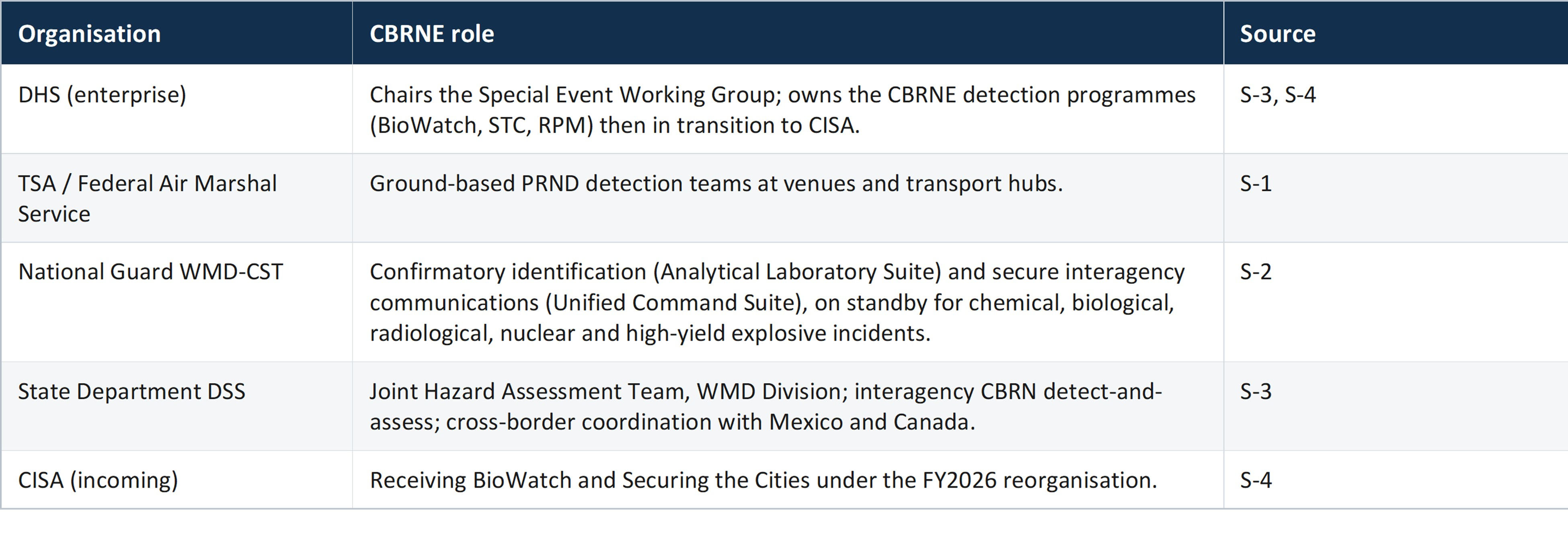
ASSESSMENT (Confidence: MODERATE, Evidence: MEDIUM). The Joint Hazard Assessment Team is the most transferable CBRNE coordination mechanism documented at FWC26. It provides a standing interagency structure for hazard detection and assessment that pre-dates and outlasts any single event, and it exercised against this tournament on a dated schedule [S-3]. For LA28 planning it is a candidate baseline rather than an innovation to be rebuilt.
5 | ASSESSMENT SUMMARY AND FORWARD RISK
5.1 CBRNE domain scorecard
5.2 Forward risk to LA28 and beyond
▪ The CWMD dissolution should be tracked through completion. The transfer of BioWatch and Securing the Cities to CISA was mid-flight during FWC26. The relevant question for LA28 is whether the receiving component reaches full operational capability on those programmes before the next mega-event, or inherits a capability gap. (Watch: CIND-05.)
▪ UAS-borne CBRN dispersal is the convergence threat. The Freedom 250 plot demonstrated domestic intent to weaponise UAS; the counter-UAS architecture handled a high-volume nuisance population but was not tested against a determined CBRN-dispersal payload. This is where the C and B domains meet the E domain, and it is the most likely direction of future CBRNE innovation. (Watch: CIND-04.)
▪ The chemical point-detection gap should be closed on the record for LA28. Confirmatory identification is not early warning. If a distributed chemical-detection grid was deployed at FWC26, it should be documented in planning; if it was not, that is a capability decision that should be made deliberately rather than by omission.
▪ The biological outcome is not yet known. The single most important post-event CBRNE indicator is the CDC MMWR on the tournament’s mass-gathering surveillance, which will not publish for months. Until it does, the biological judgement stays provisional. (Watch: CIND-02.)
5.3 Collection priorities
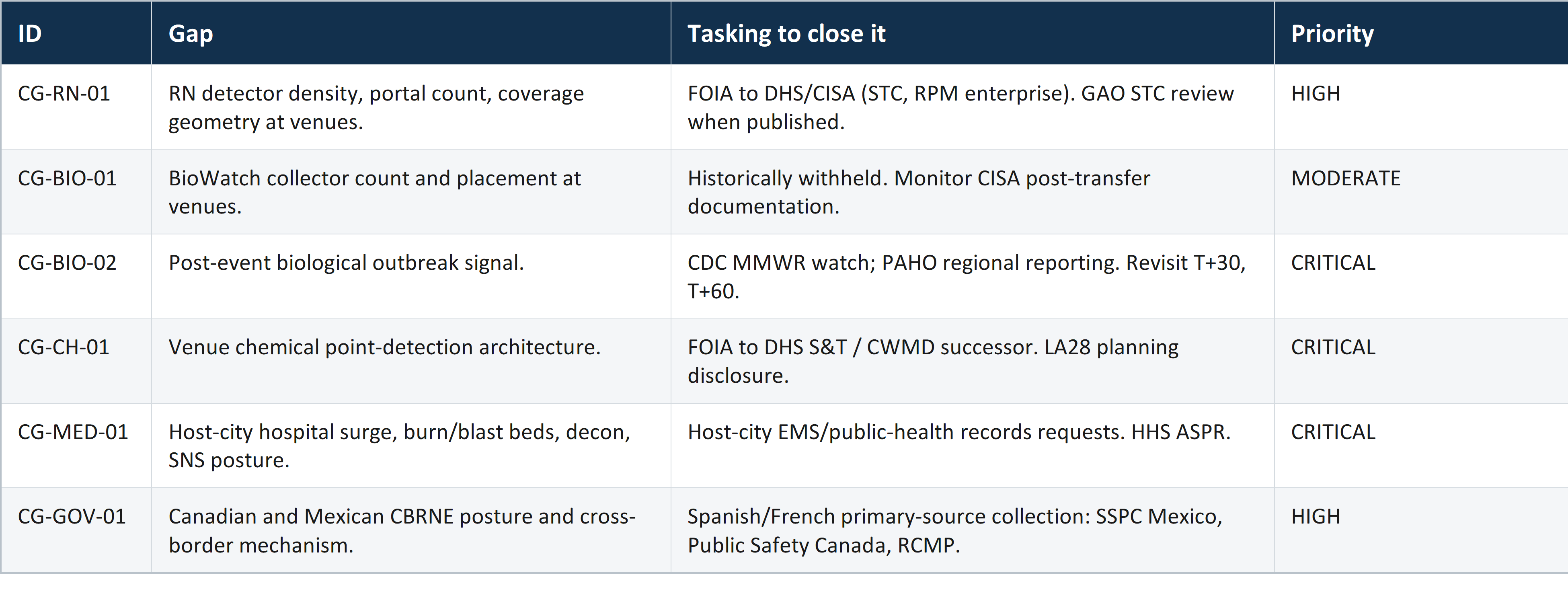
The gaps in this assessment are collectable. In priority order: the post-event CBRNE after-action and any Inspector General review of the CWMD transition during the event; the CDC MMWR on biosurveillance outcome; the Freedom 250 trial record, which will expose the explosive-UAS tradecraft in detail; and Spanish and French-language primary sources on the Mexican and Canadian CBRNE posture, which are the only route to closing the cross-border gap. These are itemised with tasking in Annex A.
ANNEX A | SOURCE REGISTER AND COLLECTION PLAN
A.1Sources
A.2 Gaps and tasking
A.3 Tier-4 watch (post-event, currently empty by design)
The definitive CBRNE documentation does not exist yet. Monitors are set against expected publication: the CDC MMWR on mass-gathering surveillance (est. late 2026 to early 2027); a DHS Inspector General review of CBRNE readiness and the CWMD transition (est. late 2026 to mid 2027); a GAO review of Securing the Cities and mega-event RN detection (est. 2027); the Freedom 250 trial record and exhibits (2026 to 2028); and any National Guard Bureau WMD-CST after-action product (est. 2027). These are the documents that will convert the provisional judgements above into findings.